Brainstorming Page
Computer System Diagram
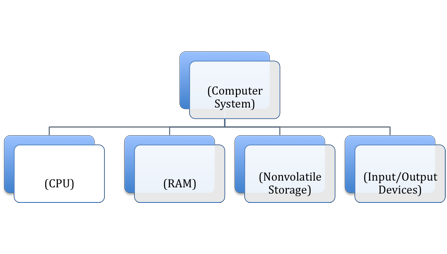
Example 1 - This analogy substitutes a woodworking workshop system as an analogy for a computer system. All woodworking workshop systems (the workshop system is the computer system) use raw materials such as lumber, glue, etc. (the lumber, glue, etc. is the data). The woodworking workshop gets the raw materials from a nearby woodshed, which stores the materials (the nearby woodshed that stores the materials is the RAM). The lumber is transformed in the workshop (the workshop is the CPU). The lumber (data) can be transformed in the workshop (CPU) into a knickknack or a table or whatever item is specified in a customer's request (where the customer request is the input). The knickknack can be sent via trucks (where the nicknack is the output sent via the trucks, where the trucks are the output device) to the customer.
Example 2 – The example from the video– This analogy substitutes human beings as an analogy for a computer system. The human brain (which is the CPU) receives information from our senses (where our senses are the input devices) and sends it through our memory (RAM) along with our prior knowledge to our brain (the CPU). The brain uses the information and allows us to respond. We may respond by speaking (where our voice is an output device). The last thing the brain needs to do is make a memory (where our memories are Nonvolatile storage) so we can remember it tomorrow.
Brainstorming Rules – Most problems are not solved by the first idea. Brainstorming helps you generate multiple ideas. Afterwards, you evaluate the listed ideas. Follow the below directions for Part 1- Idea Generation and Part 2 - Idea Evaluation. Print or download
Part 1 – Idea Generation |
Part 2 – Idea Evaluation |
Allow everyone to contribute ideas as they come to mind |
Remove repeats or similar ideas |
Choose a recorder to record the ideas |
Group like concepts together |
Be careful not to evaluate or criticize ideas during Part 1, just write them down |
Eliminate those that definitely will not work |
All answers are helpful, none are wrong, just write them down |
Discuss remaining ideas |
Record Part 1 Record Part 2
|
|